
TMJ/TMD Therapy
Custom Night Guards
Custom appliances to protect against grinding and clenching.
What is the temporomandibular joint?
The temporomandibular joint (TMJ) is the hinge-like joint that connects your lower jaw to the skull, just in front of each ear. It lets you open and close your mouth, chew, and speak. You have two TMJs, one on each side, and they work together.
When problems affect the joint, the surrounding muscles, or both, they are called temporomandibular disorders (TMD). TMD is quite common and can range from mild and occasional to persistent and disruptive. Jaw pain, headaches, clenching, and clicking joints can all be related to it.
Symptoms of TMD
Symptoms vary a lot, and some may seem unrelated to the jaw at first. Common signs include:
- Jaw pain or soreness, especially in the morning or after eating
- Clicking, popping, or grating sounds when opening or closing the mouth
- Difficulty opening the mouth fully, or the jaw locking open or closed
- Headaches, especially around the temples
- Earaches or a feeling of fullness in the ears (without an ear infection)
- Facial muscle tension or soreness
- Worn, flattened, or sensitive teeth from clenching or grinding (bruxism)
- Neck and shoulder tension
What causes TMD?
TMD usually results from a combination of factors rather than a single cause. Common contributing factors include:
- Bruxism (clenching and grinding). This often happens during sleep and puts sustained, significant force on the joint and jaw muscles.
- Bite discrepancies. When the upper and lower teeth do not meet evenly, the joint can take uneven stress.
- Stress and muscle tension. Stress often shows up as jaw clenching, which can bring on or prolong symptoms.
- Injury or trauma. A direct blow to the jaw or a whiplash-type injury can affect the TMJ.
- Joint changes. Some people develop changes in the joint's internal structure over time.
Treatment approaches
Treatment is tailored to you, based on the type and severity of your symptoms. Options include:
Custom night guard (occlusal splint)
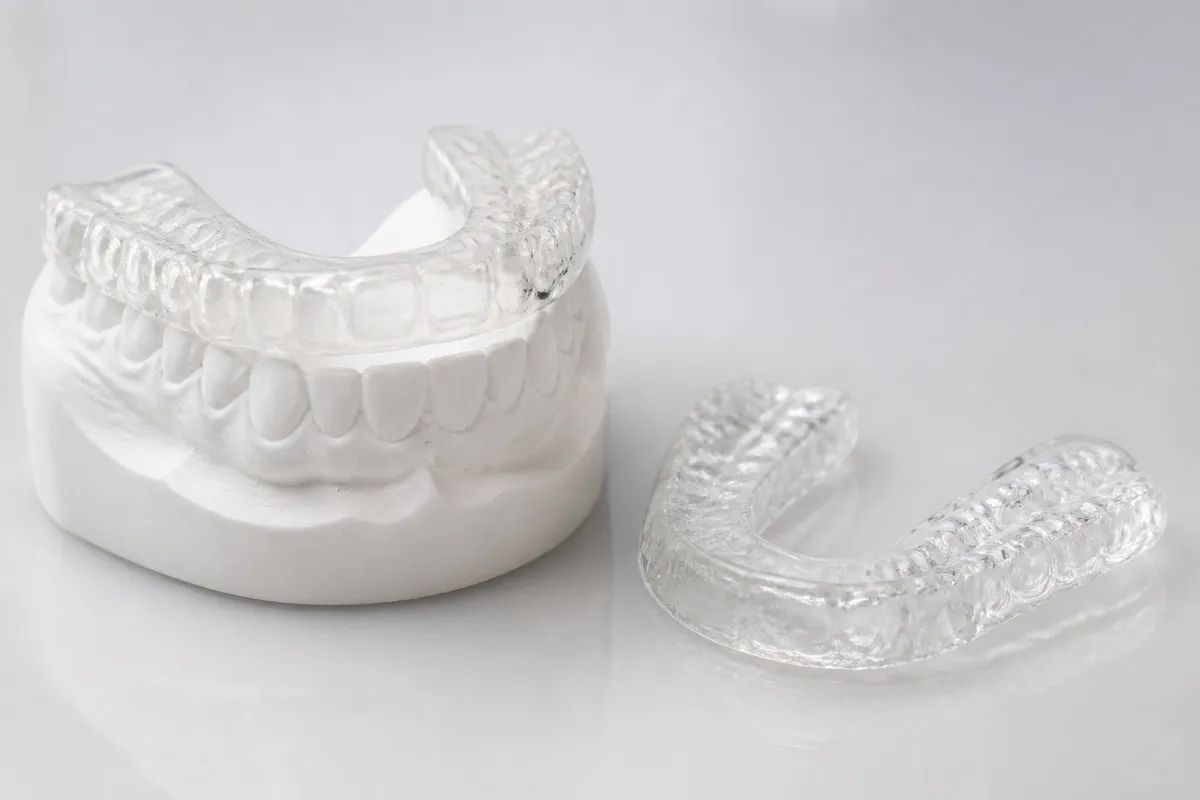
A night guard is a custom-made appliance worn over the teeth during sleep. It creates a protective barrier between the upper and lower teeth, preventing the tooth-to-tooth contact that happens with grinding, and helps reduce the force passed to the jaw joint and muscles. Custom guards are made from impressions taken at the office and fit far more accurately, and comfortably, than over-the-counter options.
Bite adjustment
In some cases, minor reshaping of specific tooth surfaces can improve how the teeth come together and reduce uneven loading on the joint. This is assessed case by case. See bite correction.
Physiotherapy referral
For patients with significant muscle involvement, referral to a physiotherapist experienced with jaw and craniofacial conditions can complement dental treatment.
Botox for jaw tension
When conservative measures are not enough, Botox for TMJ and facial pain may be discussed as an additional option.
Custom night guards vs. over-the-counter options
Pharmacy night guards, including boil-and-bite types, offer limited precision. Because they do not fit closely to your teeth, they can shift during sleep, create an uneven bite surface, and in some cases increase clenching instead of reducing it.
A custom appliance is made from detailed impressions of your teeth and is designed to spread force evenly across the dental arch. The result is a more stable, comfortable device that you are more likely to wear consistently.
Looking for a sports mouthguard?
Custom night guards on this page are for jaw and TMJ symptoms. Sports mouthguards and general night guards are covered under preventive dentistry.
Ready to Book?
Call us or book an appointment online. New patients are welcome.
Book Appointment 780-432-3430