
Endodontic Services
Cracked Tooth Treatment
Diagnosis and treatment to restore cracked teeth.
What is cracked tooth syndrome?
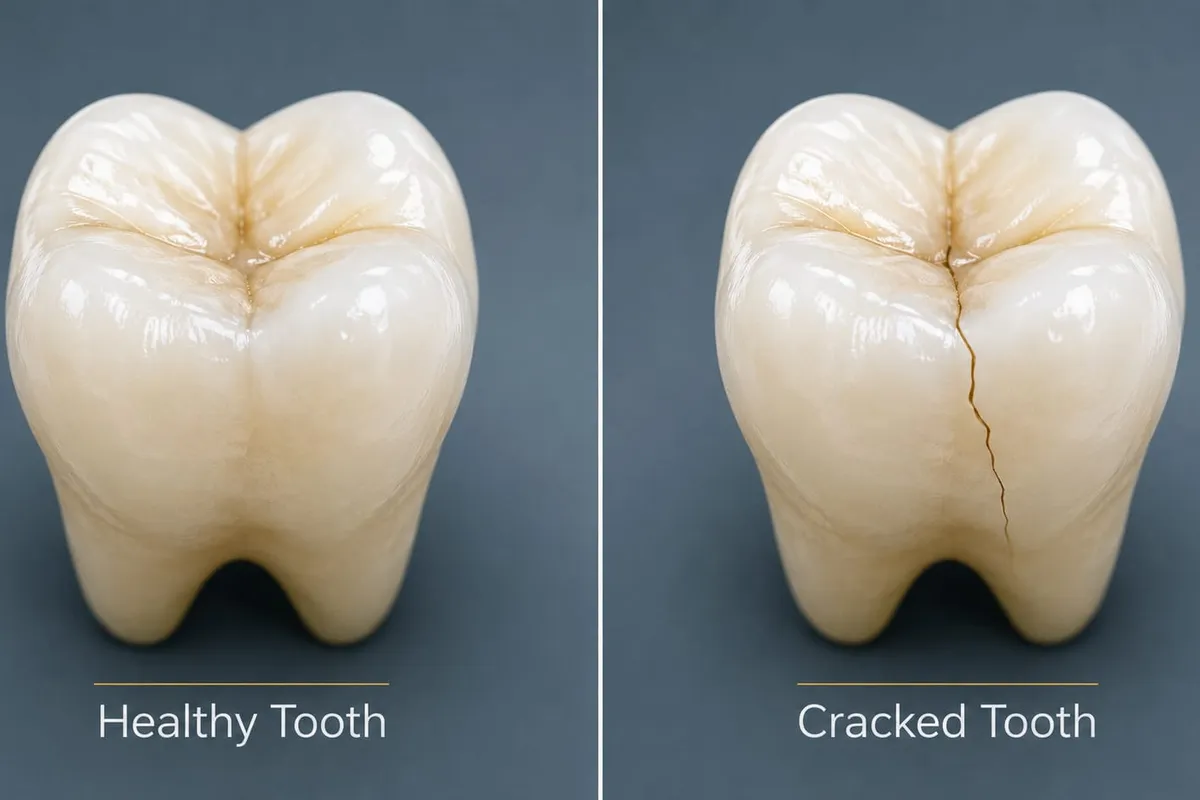
Cracked tooth syndrome is pain or sensitivity caused by a crack in a tooth. It often shows up as pain when biting or chewing, or a sharp, brief pain when you release your bite. The discomfort tends to come and go, and it can be hard to tell which tooth is causing it or when it will happen.
Unlike a fracture that visibly splits the tooth, many cracks are incomplete. They extend into the tooth but do not break a piece off, which makes them harder to find and harder to diagnose with certainty.
Why cracks develop
Teeth can crack for a number of reasons:
- Grinding and clenching (bruxism): ongoing clenching or grinding puts heavy, repeated force on the teeth, which can cause cracks over time. A custom night guard can help protect teeth.
- Chewing hard objects: biting down on hard foods, ice, or non-food items can start or extend a crack.
- Large fillings: teeth with large fillings have less natural tooth structure to support the biting load, which can raise the risk of cracking over time.
- Temperature changes: repeated exposure to extreme temperature changes can contribute to cracks in some teeth.
- Trauma: a direct blow can crack a tooth even if it does not visibly break.
Types of tooth cracks
Craze lines
Fine surface cracks in the outer enamel only. They are very common and usually need no treatment. They do not cause pain and do not weaken the tooth.
Fractured cusp
A piece of the biting surface breaks away, often around a large existing filling. The fracture usually does not reach the pulp, and the tooth can be restored with a new filling or a crown.
Cracked tooth
A crack that starts at the biting surface and runs down toward the root, without splitting the tooth into separate pieces. Depending on how far it goes, treatment may involve a crown, root canal treatment, or both. The sooner a crack like this is treated, the more options there are.
Split tooth
The crack has gone all the way through the tooth, leaving separate segments. A split tooth usually cannot be saved whole. Part of it can sometimes be kept, but extraction is often needed.
Vertical root fracture
A fracture that starts in the root and runs upward. These often cause no symptoms for a long time and may only be found when the surrounding bone and gum show signs of infection. Extraction is usually needed.
Symptoms
The symptoms of a cracked tooth vary a lot. Common ones include:
- Sharp pain when biting down, or when releasing your bite
- Sensitivity to cold or heat that may linger
- Discomfort that comes and goes and is hard to reproduce
- Difficulty telling which tooth is causing the pain
Because the symptoms come and go, cracked tooth syndrome can be one of the harder dental problems to diagnose.
How cracks are diagnosed
No single test reliably finds every crack. Diagnosis usually combines several approaches:
- A detailed history of when and how the pain happens
- Bite tests with a bite stick to reproduce the pain and isolate the tooth
- Transillumination, shining a light through the tooth to reveal cracks
- A visual exam, including staining agents that can highlight crack lines
- X-rays, though many cracks do not show up on x-rays
Sometimes a crack cannot be seen until the tooth is examined under magnification or in certain lighting. The dentist will take the time needed to carefully find the source of your symptoms.
Treatment
Treatment depends on the type, location, and extent of the crack:
- A crown is often recommended to hold the tooth together and stop the crack from spreading under biting forces.
- If the crack has reached the pulp, root canal treatment may be needed before the crown is placed.
- A split tooth or vertical root fracture may need extraction if the tooth cannot be kept.
Cracks that reach toward or into the root are generally harder to treat, and finding a crack early leaves more options. If you have biting pain or sensitivity that comes and goes, it is worth having it checked sooner rather than later. Call 780-432-3430 to book an assessment.
Ready to Book?
Call us or book an appointment online. New patients are welcome.
Book Appointment 780-432-3430